
Data access
MetabolomicsWorkbenchAPI.jl
Retrieve and organize public metabolomics studies.
Repository →Open-source Julia software
A collection of Julia packages for high-dimensional biomedical data analysis.
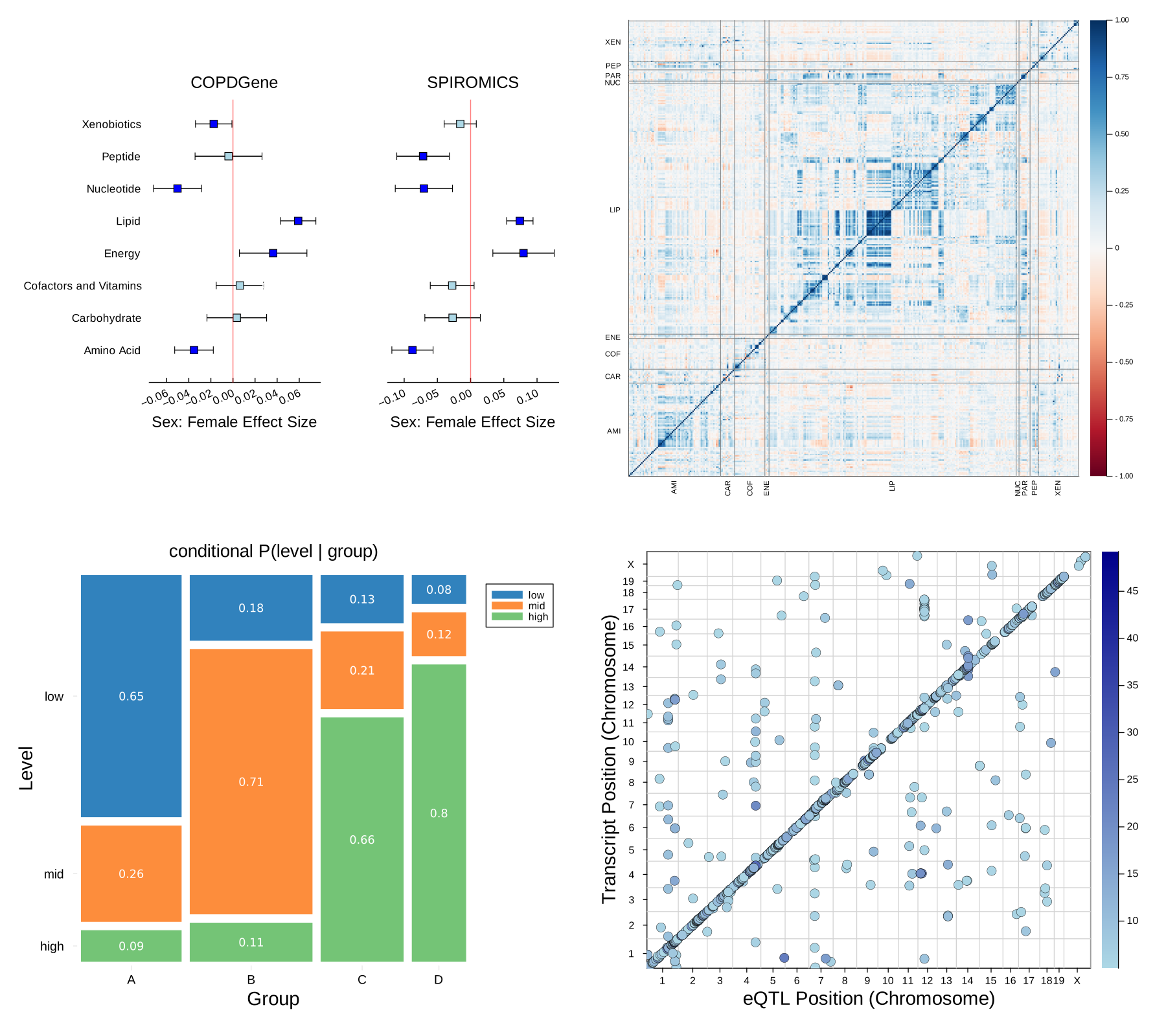
About
BigRiver groups Julia packages for data access, dimension reduction, matrix modeling, QTL analysis, and visualization.
Each package can be used on its own or combined with the others in a reproducible workflow.
Packages
Data access
Retrieve and organize public metabolomics studies.
Repository →Dimension reduction
Apply dimension-reduction methods to large data matrices.
Repository →Statistical modeling
Fit matrix linear models for structured, high-throughput data.
Repository →QTL analysis
Analyze quantitative traits with multivariate linear mixed models.
Repository →Visualization
Create statistical graphics with lightweight plotting recipes.
Repository →Data preprocessing
Preprocess omics data through imputation, normalization, and transformation.
Repository →QTL analysis
Support QTL preprocessing, genome scans, and visualization workflows.
Repository →Statistical modeling
Run linear mixed-model genome scans across many traits.
Repository →Data storage
Read and write a fast, flexible format for tabular numerical data.
Repository →Data access
Access GeneNetwork data through its REST API from Julia.
Repository →Visualization
Provide Makie plotting recipes for BigRiver metabolomics workflows.
Repository →Visualization
Create statistical plots for QTL and eQTL analyses.
Repository →QTL analysis
Perform lightweight, near real-time eQTL genome scans.
Repository →Organization
Browse related methods, examples, and supporting software.
All repositories →Applications
Study genotype–phenotype relationships with mixed-model and QTL methods.
Model associations between sample characteristics and molecular features.
Analyze structured effects across high-throughput experimental conditions.